How to Build a Behavioural Lead-Scoring Engine in Your CRM
Expert guide to implementing an advanced behavioural lead-scoring engine in your CRM sales process, with workflows, benchmarks and decision logic.

Rasmus Rowbotham
Founder of Foundbase and experienced entrepreneur with over 10 years of experience in building and scaling businesses.
Definition
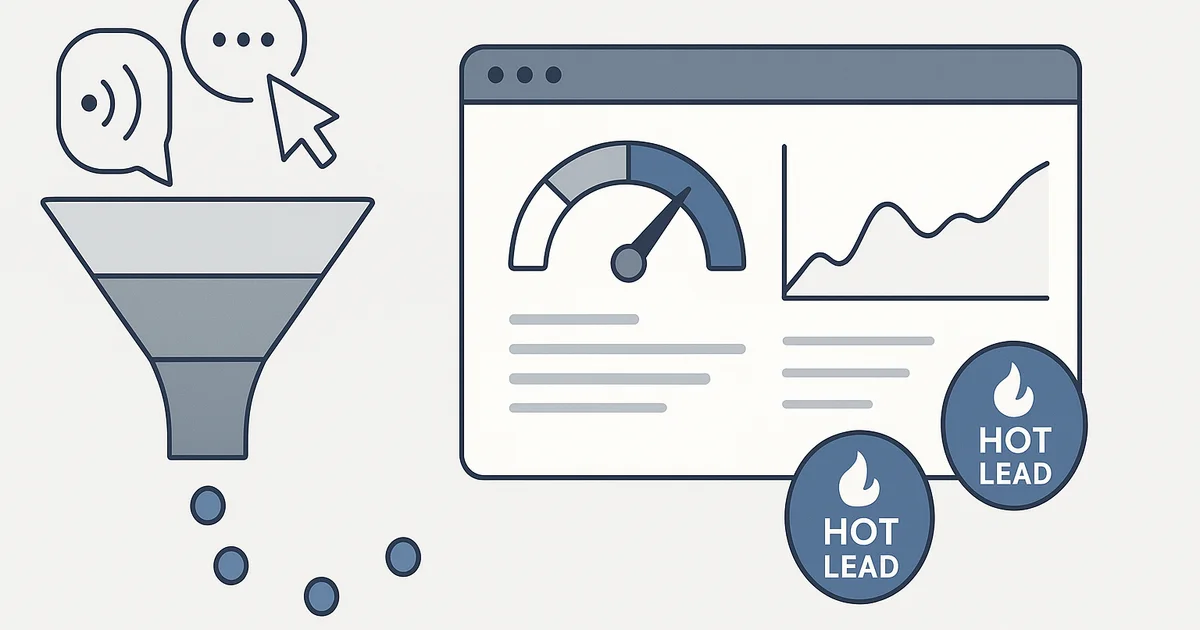
A behavioural lead-scoring engine in a CRM is a structured scoring system that assigns points to leads based on digital behaviour and sales interactions – designed to prioritise the leads with the highest likelihood to convert to customers.
Key Facts:
- Companies using systematic lead-scoring models typically report conversion rate improvements of ~10-15 % from Marketing Qualified Lead (MQL) to Sales Engagement. :contentReference[oaicite:3]{index=3}
- An effective scoring model often uses 20-30 datapoints per lead (site visits, email clicks, demo booking, chat interaction, product usage).
- Modern CRM platforms support real-time scoring updates when behavioural triggers fire. :contentReference[oaicite:4]{index=4}
- Combining behaviour-based scoring with value metrics (monetary) and frequency (how often) improves accuracy — e.g., via RFM concepts. :contentReference[oaicite:5]{index=5}
- Continuous maintenance is mandatory: leads with no engagement in 90+ days should be archived or re-activated to preserve scoring precision.
When to Use vs When to Avoid
When to use:
- If you receive a high lead volume (e.g., >500/month) from marketing and your sales team struggles to prioritise.
- If sales reps often chase low-quality leads and conversion rates are low.
- If you have multi-channel interaction data (website analytics, email, product usage) integrated into your CRM.
When to avoid:
- If you have very low lead volumes (e.g., <50 per year) and manual qualification still works.
- If your CRM and marketing stack are not integrated, so you cannot reliably track behaviour across channels.
- If you lack the data-ops or governance resources to maintain a scoring model — it may degrade into noise.
Comparison: Basic Score vs Advanced Score vs Behavioural Score
| Feature | Basic Scoring (e.g., industry + company size) | Advanced Scoring (behaviour + value weighting) | Behavioural-based Real-time Scoring |
|---|---|---|---|
| Data Depth | Low | Medium | High |
| Automation Level | Manual | Semi-automated | Automated real-time |
| Scoring Accuracy | Low | Moderate | High |
| Resource Requirement | Low | Moderate | High (data + tech infrastructure) |
| Main Risk | Over-simplification | Over-complexity | Maintenance burden |
Three major trade-offs
- Automation vs. oversight: Real-time triggers reduce manual work but risk mis-routing leads if governance is weak.
- Depth vs. transparency: Complex models yield better precision but may confuse sales teams and reduce acceptance.
- Maintenance burden vs. stability: High-precision models need regular review of weights, datapoints and exclusions — without governance they degrade.
Before/After Example
Before: Leads are scored only on industry + company size; sales contacts all leads; MQL→SalesIntro = 3 %.
After: Behavioural scoring implemented: site visits >3 + email clicks >1 + demo booked → score>70 → flagged as hot lead for sales; score<30 → nurture track. MQL→SalesIntro improved to 9 %.
Actionable Options (3-tier) with trade-offs and audiences
- Option A: Basic behaviour scoring (Level 1)
– Implementation: define ~5-10 behaviour signals in CRM.
– Risk: Limited precision; manual monitoring still needed.
– Assumption: CRM supports custom scoring, you can integrate basic data.
– Who: Smaller firms with moderate lead flow and modest tech capacity. - Option B: Medium scoring with value weighting (Level 2)
– Implementation: behavioural signals + value factors (deal size, users) + automated segment flags.
– Risk: More complex setup and ongoing tuning.
– Assumption: You have historical data to calibrate weights and segments.
– Who: Organizations with stable lead flow and sales teams seeking better prioritization. - Option C: Real-time trigger scoring + AI (Level 3)
– Implementation: real-time data stream (web, chat, product usage) + dynamic scoring + alerts/automation for actions.
– Risk: High infrastructure requirement, higher cost, risk of mis-fires.
– Assumption: Data platform/RevOps team in place; many leads, long sales cycles, complex decisions.
– Who: Growth companies with large lead volumes, advanced analytics, and desire for next-level prioritisation.
Implementation Workflow (8 steps)
- Define business goal: e.g., improve MQL→SalesIntro conversion by 50 % in 90 days.
- Identify behavioural datapoints: site visits, email clicks, demo bookings, chat/interactions, product usage logs.
- Define scoring values: assign points to actions (e.g., demo booked = 50 pts; email click = 10 pts).
- Configure CRM: build custom field ‘Lead Score’, integrate behaviour data, set up automation for score update.
- Define segments and triggers: e.g., Score>70 → auto-assign to sales; Score 30-70 → nurture marketing; Score<30 → automated low-touch marketing flow.
- Train sales and marketing teams: explain scoring logic, how leads are prioritised, ensure buy-in.
- Monitor & analyse: track conversion rates, time-in-pipeline, average deal size; refine scoring weights as needed.
- Govern and maintain: audit model quarterly—review datapoints, weights, exclusion lists, stale leads (no engagement >180 days) move to re-engagement or archive.
Measurable benchmarks
| KPI | Target Range |
|---|---|
| MQL→SalesIntro conversion | From ~3 % up to 8-12 % |
| Avg sales cycle length | Reduce by 15-25 % |
| Pipeline value per salesperson | Increase by 10-30 % |
Decision Block
If you are new to scoring and have limited resources → choose Option A.
If you have a stable lead stream and want better prioritisation → Option B.
If you have high lead volume, strong tech/data capability and aim for real-time prioritisation → Option C.
90-Day Action Plan
Days 0-30: Define goals, identify behavioural datapoints, build scoring spreadsheet, configure CRM.
Days 31-60: Run pilot on one lead source, train marketing/sales, begin segmenting leads via scoring.
Days 61-90: Analyze results, adjust scoring weights, full rollout, establish governance process (monthly review of model).
Internal Linking
To build your full lead-to-deal flow and automation, refer to our article on CRM Automation Framework and the difference between leads and deals in Lead vs Deal in CRM. For evaluating free CRM systems supporting scoring, see Best Free CRMs 2025.
Frequently asked questions
Q: How often should I update the lead score in my CRM?
Ideally the lead score should update in real-time or at least daily, depending on interaction volume. If you refresh it only monthly then the score may no longer reflect current interest and you lose the prioritisation advantage.
Q: What types of data feed into a behavioural lead scoring model?
High-value data types include: (1) engagement behaviour (site visits, email clicks, demo/webinar participation), (2) sales interactions (meeting scheduled, proposal sent) and (3) value-indicators (deal size, number of users, budget). Behaviour gives signals of interest, value gives potential profitability.
Q: How do I avoid the scoring model being a ‘black box’ for the sales team?
Make the scoring transparent – show the components of the score, publish thresholds (e.g., score>70 = hot). Engage the sales team during setup and review so they understand why a lead is getting that priority and buy into the process.
Related guides

crm for lead conversion optimization: boost sales
Discover how to optimize your CRM to improve lead conversions. Gain insights into strategies and practical tips to boost your sales.
Rasmus Rowbotham
crm for startup customer success: Boost growth
Discover how crm for startup customer success can enhance your business growth. Implement effective strategies and tools for small teams.
Rasmus Rowbotham
crm customization for startups: Boost efficiency
Learn how to customize your CRM for your startup and enhance efficiency. Get tailored solutions and optimize your business.
Rasmus Rowbotham