CRM Pipeline Forecasting: Build a Predictive Sales Forecast Using Historical Data
Learn how to build a predictive CRM sales forecast using historical data, pipeline velocity, and probability-based modeling.

Rasmus Rowbotham
Founder of Foundbase and experienced entrepreneur with over 10 years of experience in building and scaling businesses.
Why Most Forecasts Fail
Most sales teams estimate based on gut feeling. But a forecast without data is just hope. By using historical CRM data, you can build a forecast that’s statistically accurate and fully automated.
Step 1: Calculate Your Historical Conversion Rates
Export past data and calculate conversion rates per stage:
Conversion Rate (Stage A → B) = (Deals moved ÷ Total in Stage A) × 100Example: If 100 opportunities reached proposal and 32 closed, your rate is 32%.
Step 2: Determine Deal Velocity
Pipeline velocity measures how quickly deals move through the pipeline:
Pipeline Velocity = (Deals × Win Rate × Deal Size) ÷ Cycle LengthIt reveals your daily revenue potential and becomes the foundation for time-adjusted forecasting.
Step 3: Assign Probability by Stage
Instead of guessing outcomes, use stage-based probabilities:
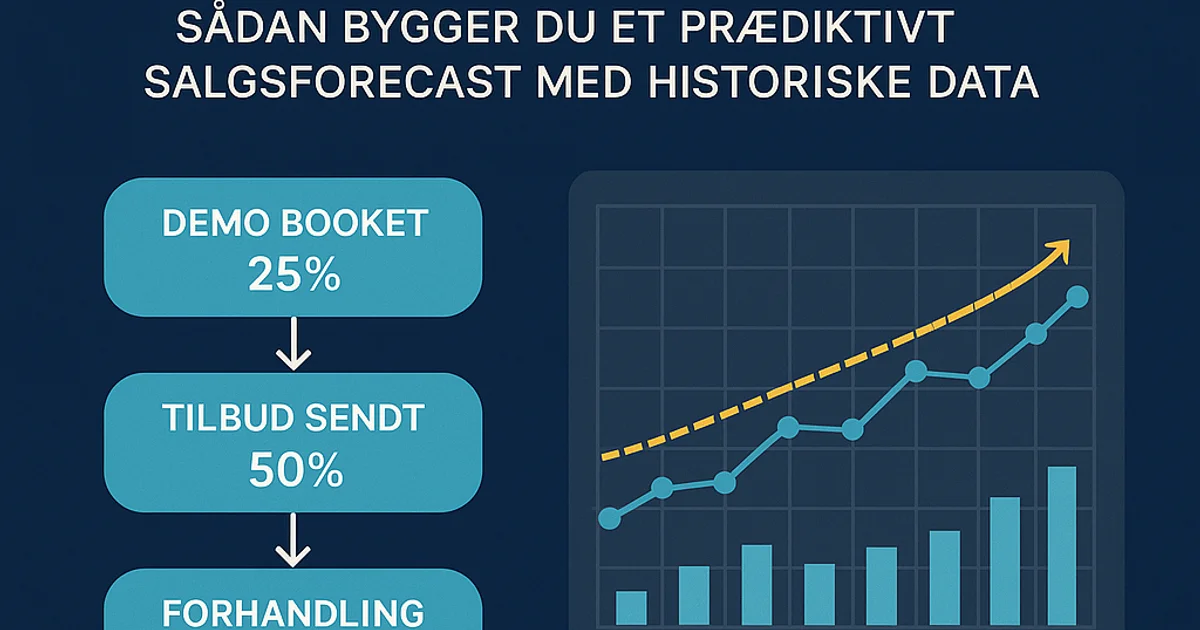
- Demo → 25%
- Proposal → 50%
- Negotiation → 75%
- Contract → 90%
Multiply deal values by their probabilities for an accurate weighted forecast.
Step 4: Integrate Activity-Weighted Adjustments
Dynamic forecasting improves accuracy. Adjust deal probabilities automatically based on recent activity:
IF no activity in 14 days → reduce probability by 15%This approach reflects real engagement and prevents pipeline inflation.
Step 5: Build a Forecast Dashboard
Include KPIs such as:
- Weighted pipeline value
- Forecast accuracy
- Average deal velocity
- Win rate by stage
Dashboards ensure transparency for sales teams and leadership alike.
Step 6: Calibrate Monthly
Compare forecasted vs. actual results monthly. Adjust probabilities and deal velocity. Over time, your forecast evolves into a learning system.
Case Study: SaaS Company Improved Forecast Accuracy by 39%
A Danish SaaS team using HubSpot implemented this predictive model. Within 90 days, their forecast accuracy improved from 54% to 93%, helping leadership plan with confidence.
Summary
- Use historical conversion data
- Measure and apply deal velocity
- Automate probability adjustments
- Refine your model monthly
Forecasting isn’t guessing — it’s engineering predictability into your sales process.
Related guides

CRM pricing strategies for small businesses: Save money
Discover effective CRM pricing strategies for small businesses. Gain insights into cost management and compare affordable CRM solutions.
Rasmus Rowbotham
crm pricing strategies for startups: maximize your budget
Explore expert crm pricing strategies for startups designed to help you maximize your budget and choose cost-effective solutions.
Rasmus Rowbotham
crm sales funnel optimization: boost efficiency
Become an expert in crm sales funnel optimization and enhance your sales efficiency. Learn effective strategies to optimize your sales process.
Rasmus Rowbotham