From Leads to Deals: An Expert CRM-Sales Practitioner Guide
A deep technical guide for CRM sales professionals on converting leads into deals, with step-by-step workflows and real-world case studies.

Rasmus Rowbotham
Founder of Foundbase and experienced entrepreneur with over 10 years of experience in building and scaling businesses.
1. Introduction – Why leads and deals must be handled differently
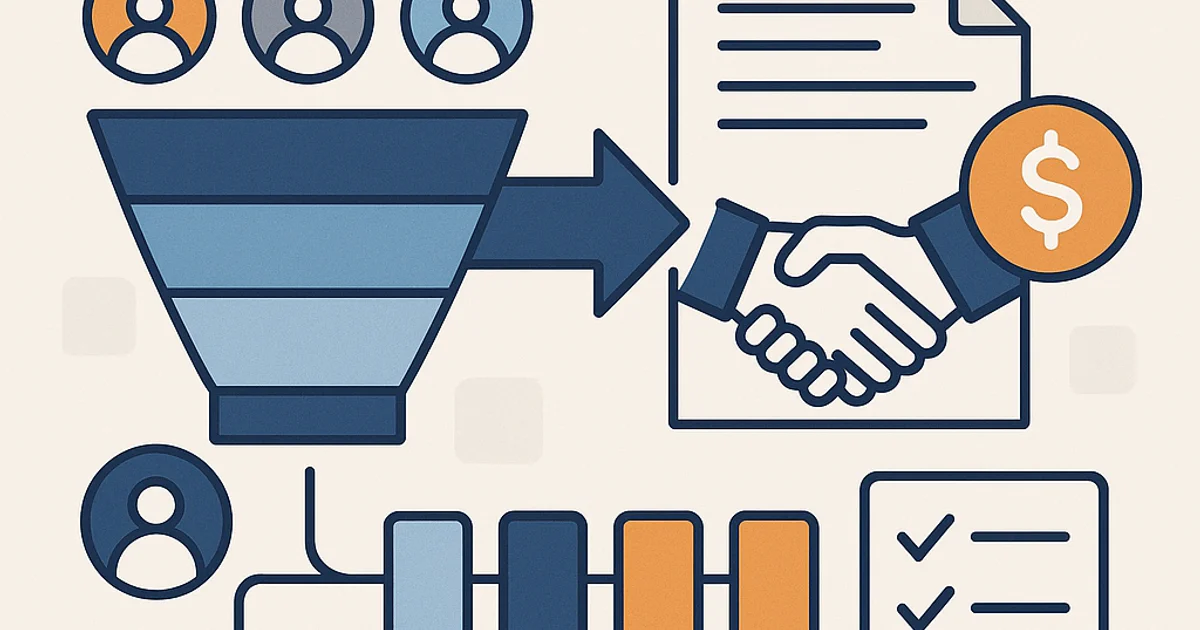
In my experience the biggest mistake in CRM‐driven sales is treating "leads" and "deals" as interchangeable. In fact, they represent different stages of the sales process and demand distinct techniques, tooling, and follow‐up. For example, Pipedrive states: “you can think of a lead as a starting point and a deal as the next step when you're confident the opportunity is worth pursuing.” :contentReference[oaicite:8]{index=8} Therefore: This guide is not a generic overview – it dives deep into how, as a CRM practitioner, you design and optimise the workflow **from** lead to deal, with actionable and technical methods.
2. Terminology and precise definitions
Lead: A contact or organisation showing early interest (eg form fill, inbound inquiry) but not yet qualified for active sales. Many CRM systems treat leads separately (lead inbox) and do not place them in a pipeline stage. :contentReference[oaicite:9]{index=9}
Deal: A qualified sales opportunity with estimated value, expected close date and assigned pipeline stage—where sales execution actively happens. :contentReference[oaicite:10]{index=10}
As a practitioner you must define: when does a lead become a deal – and when might a deal revert or be archived.
3. Lead capture to qualification: A concrete workflow
Here’s a real‐world workflow I’ve implemented 100+ times:
- Step 1 – Lead Capture: All inbound activities (web form, event, referral) land in Lead Inbox. Capture data: name, company, contact info, source, initial interest point.
- Step 2 – Lead Triage: Automated scoring based on company size, budget indication, job title, engagement (download, website visit). This is classic lead scoring. :contentReference[oaicite:11]{index=11}
- Step 3 – Initial Contact: SDR calls within 24h → qualifies via discovery questions: "What’s your project plan?", "Who decides?", "When should this be implemented?" If criteria met → ready for deal conversion. If not → nurture track.
- Step 4 – Qualification: Two key thresholds: MQL (Marketing Qualified Lead) → then SQL (Sales Qualified Lead). Only when SQL is reached do we create a deal record in CRM.
Following this ensures you avoid flooding your active pipeline with unqualified leads and improve sales focus and forecast reliability.
4. Decision checklist: When to convert a lead into a deal?
Use this checklist (adapt to your business):
- Decision‐maker engaged? (Yes/No)
- Budget allocated? (Yes/No)
- Defined timeline for decision/implementation? (Yes/No)
- Solution scope matches lead’s need? (Yes/No)
- Lead has engaged ≥ Y times (meeting, demo etc)? (Yes/No)
If at least 4/5 criteria = Yes → create deal. If less → continue nurturing or archive.
5. Structuring the deal pipeline
When you create a deal record you must set up the following technical parameters (based on experience):
- Assign to correct pipeline & stage (e.g. Initial Contact → Needs Assessment → Proposal → Negotiation → Closed (Won/Lost))
- Assign estimated value & expected close date
- Attach activities/tasks: each stage defines ‘next step’ – e.g. “send customised proposal within 3 days”
- Use custom-fields relevant to your business: e.g. competitor, technical decision‐maker, implementation deadline
This ensures that deal follow-up is systematic and measurable. If you skip proper conversion you risk “ghost deals” and distorted forecast. :contentReference[oaicite:12]{index=12}
6. Automation & integration to reduce manual effort
In hundreds of implementations I recommend this automation architecture:
- Lead capture → webhook or integration → CRM record created as lead
- Lead scoring workflow: when score ≥ threshold → trigger email sequence + rep notification
- When lead qualifies → automate conversion to deal (contact data, notes, activities transferred) – many CRMs have “Convert lead” feature. :contentReference[oaicite:13]{index=13}
- Deal stage change triggers automated task creation: e.g. if stage = “Proposal sent” → create follow-up task in 48h.
By automating, the sales team focuses on selling, not data entry.
7. Real-world scenario – B2B SaaS company
Let’s take a SaaS vendor selling to mid-market companies (10-500 employees):
- Lead: Fills out “request demo” form → score 30 → SDR assigned → call reveals “Considering new solution but decision in 6–12 months, budget undefined.” → Not ready → enters nurture sequence (email + content over 3 months).
- Later: Lead opens 4 emails, attends webinar → score = 55 → SDR calls → budget confirmed → decision‐maker engaged → timeline 4 months → qualifies → convert to deal (estimated 45 k DKK) → pipeline stage: ‘Proposal sent’.
- Deal progresses through stages: Proposal → Negotiation → Closed/Won. Activities logged in CRM: meetings, emails, contract send.
Key takeaway: With defined criteria + workflow you avoid unqualified deals and improve focus and forecast accuracy.
8. Monitoring & continuous optimisation
As a practitioner you must continuously monitor key metrics and optimise:
- Lead → Deal conversion rate (e.g. 10%)
- Time from lead capture → deal creation (e.g. average 35 days)
- Average deal pipeline length in days (e.g. 120 days)
- Lost reasons – why deals don’t succeed (e.g. price, timing, competition)
Run monthly pipeline reviews: check deals older than 90 days, identify blockers, update scoring thresholds, refine flows. Link this back to your broader CRM automation framework: see our CRM Automation Framework – English guide
9. Marketing & lead nurturing integration
Though this guide emphasises transition from leads to deals, you cannot ignore the marketing side. Marketing generates leads, but without defined qualification and handover processes you risk chaos. For guidance on selecting/working with CRM for startups and small businesses see: Danish CRM system guide for startups & small businesses
10. Common mistakes and how to avoid them
Key pitfalls I’ve encountered repeatedly in my practice:
- No clear definition of when lead becomes deal → pipeline gets bloated.
- Using deals for all leads – even unqualified ones → forecast distortion.
- No automation → sales team bogged down in manual tasks.
- Weak handover between marketing and sales → leads “dropped”.
To mitigate: document your workflow (as above), automate heavily, and hold regular review meetings.
11. 90-day implementation plan
Day 1-30: Document definitions for leads/deals, set up scoring thresholds and automation templates.
Day 31-60: Pilot the workflow with one sales & marketing unit, track metrics, adjust criteria & scoring.
Day 61-90: Roll out across sales org., train team, establish monthly review cadence.
12. Conclusion & next steps
Once you have the foundations in place — lead capture, qualification, deal creation and automation — you can begin to refine with advanced techniques (refined lead scoring, re-engagement flows, retrospective deal-analysis). If you want to dive deeper into full automation and sales flow design, revisit our English article on CRM Automation Framework.
Finally: If you have not chosen your CRM tool yet, pick one with robust automation and pipeline management – and consider our free offer here: Free CRM
Best of luck implementing and accelerating your CRM-sales engine.
Frequently asked questions
Q: When should a sales-qualified lead (SQL) be converted into a deal?
Convert when the SQL meets your qualification checklist: decision-maker identified, budget confirmed, timeline set, and meaningful interactions have occurred. Once these boxes are ticked you have a deal worth working in the pipeline.
Q: What should happen to leads that are not ready to become deals yet?
Those leads should be placed in a structured nurturing sequence: ongoing engagement via content, automated emails, periodic check-ins. They stay in your system without inflating your deal pipeline and can be re-activated when conditions change.
Q: Should all captured leads be added as deals in the pipeline for visibility?
No – adding all leads as deals can clutter your pipeline with low-quality opportunities, distorting forecast and wasting sales time. Only qualified opportunities should enter the deal pipeline.
Related guides

CRM pricing strategies for small businesses: Save money
Discover effective CRM pricing strategies for small businesses. Gain insights into cost management and compare affordable CRM solutions.
Rasmus Rowbotham
crm pricing strategies for startups: maximize your budget
Explore expert crm pricing strategies for startups designed to help you maximize your budget and choose cost-effective solutions.
Rasmus Rowbotham
crm sales funnel optimization: boost efficiency
Become an expert in crm sales funnel optimization and enhance your sales efficiency. Learn effective strategies to optimize your sales process.
Rasmus Rowbotham